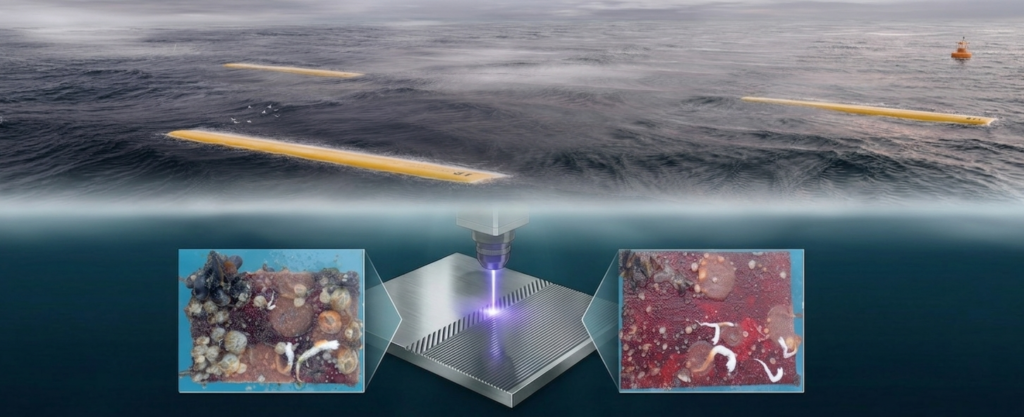

The consortium consists of partners complementing each other to advance knowledge and technologies for the offshore renewable energy sector. LOTUS-PTO unites nine partners from five European countries, Sweden, Denmark, Austria, Italy, and Ireland, in an interdisciplinary consortium to accelerate sustainable ocean renewable energy technologies.
The partnership includes two research insitutes: RISE and CNR, three Universities: Aalborg University, University of Gothenburg and Polytechnic University of Bari and four companies: OE Systems, Bionic Surface Technologies, VGA and ORPC.
The project is supported by CETP – the Clean Energy Transition Partnership and funded by five national funders.
RISE Research Institutes of Sweden is the project coordinator. A major international research institute with around 3,300 employees, RISE leads project management, antifouling efficacy testing, and dissemination. The institute contributes deep expertise in marine ocean testing, biofouling, corrosion, materials performance, and applied machine learning.
National Research Council of Italy (CNR) is Italy’s largest public research body. The Institute for Photonics and Nanotechnologies (IFN) in Bari leads the surface functionalization work, developing femtosecond ultrafast laser protocols that imprint hierarchical micro- and nano-structures onto offshore components to reduce friction, drag, biofouling, and corrosion.
Aalborg University (AAU) contributes its Visual Analysis and Perception (VAP) Lab in Denmark and leads the data-driven surface assessment work. The group builds underwater camera systems and AI models that automate marine surface monitoring, replacing periodic manual inspections with continuous, objective measurement.
University of Gothenburg (GU) brings the Lundgren biointerface group at the Department of Chemistry and Molecular Biology. The team studies how microorganisms attach to surfaces and how laser-structured topographies disrupt early biofilm formation, contributing live-cell microscopy and molecular biology methods to single-organism-resolution biofouling analysis.
Polytechnic University of Bari (POLIBA) leads the tribology testing and modelling activity through its Department of Mechanics, Mathematics, and Management. The team characterises friction, wear, and anti-adhesive performance of textured surfaces in wet conditions and connects surface geometry to tribological behaviour at relevant scales.
Bionic Surface Technologies (BST) is an Austrian R&D SME based in Graz, specialising in CFD-driven surface optimization and shark-skin-inspired riblet structures. BST runs high-fidelity LES simulations to design and evaluate textures for hydrodynamic drag reduction, working in tight loop with CNR’s manufacturing capabilities and the project’s AI optimization framework.
OE Systems (OES) is a Swedish wave energy developer based in Gothenburg. OES contributes the WaveMove™ wave energy converter as one of the project’s two industrial use cases, providing requirements, performance models, and the integration pathway for laser-structured components on a real device.
ORPC Ireland is a Dublin-based marine renewable energy company with 18 device deployments since 2010, including the first grid-connected marine energy system in the Americas. ORPC contributes the project’s tidal energy use case through its cross-flow turbine technology and brings extensive field deployment experience to LOTUS-PTO.
VGA SRL is an Italian SME active in energy, aerospace, and space, with ten years of R&D experience in the ocean renewable energy sector. VGA leads the impact assessment work, quantifying the technical, environmental, and economic benefits of the LOTUS-PTO technology through performance modelling, life-cycle assessment, and LCOE analysis for both wave and tidal use cases.